




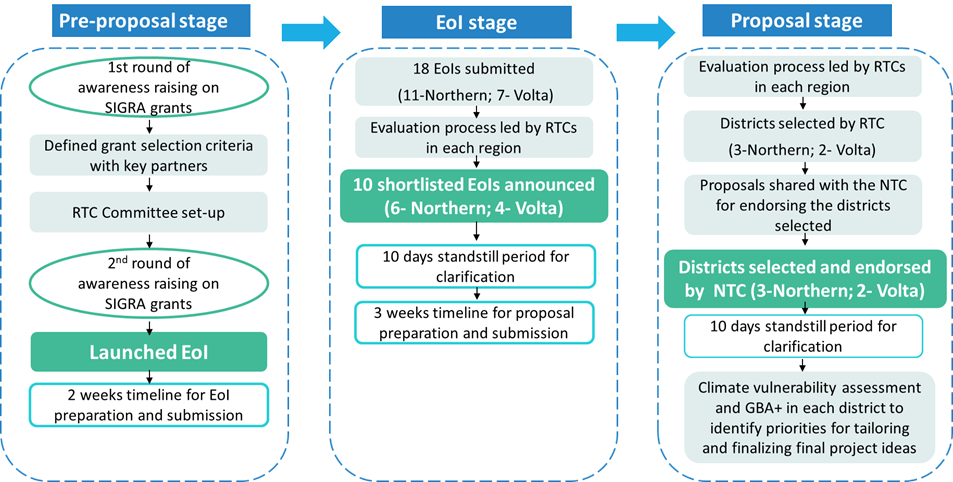
The Northen and Volta regions were selected as focus regions for SIGRA based on their vulnerability (both climate and economic vulnerability); since they have different climate profiles to learn from implementing in different environments, and due to considerations of accessibility and the cost/time for reaching target areas. For the selection of the five target districts, a two-stage open call for proposals was favoured. This process was chosen for three key reasons:
- To get the best results by selecting districts that are the most interested, responsive, and engaged with thematic focus of the project;
- As a learning exercise given one of SIGRA’s aims is to build up capacity of MMDAs for the preparation of concept notes and proposals to Climate Finance Funds. Using a proposal process for the selection allowed for an initial capacity gap assessment at both EOI and proposal stage; and
- To promote transparency and objectivity, given these are values that will be critically emphasized as part of the project’s implementation, and in this light it is crucial SIGRA also embodies these values.
The implementation of this process has proved to be a very interesting and valuable exercise.
The application process was communicated to the MMDAs through MLGDRD official channels, while awareness-raising campaigns were also run both in August 2023 and January 2024. The aim of the awareness-raising campaigns were to encourage CSOs (especially women led CSOs) to approach MMDAs and collaborate on expressions of interest (EOIs).
Results
At the EOI stage, 7 of the 25 (28%) MMDAs of the Volta region and 11 of the 16 (69%) MMDAS of the Northern Region submitted an expression of interest. 10 additional MMDAs inquired after the submission cut-off date if they could submit a late proposal, bringing up the total percentage of MMDAs interested in participating to 68%.
Following the evaluation by the 8-member Regional Technical Committee, 6 were shortlisted in the North and 4 in the Volta. Of the 10 shortlisted MMDAs all but one submitted a proposal. Following the RTC’s evaluation of the proposals, and validated by the NTC, five MMDAs were selected. Northern Region: Nanumba South, Kumbungu and Mion. Volta Region: Anloga and Akatsi North.
Gap Analysis
The district selection process was described as eye-opening by many members of the RTCs. At the EOI stage the majority of MMDAs reported not having conducted either a climate vulnerability assessment or developing a strategy to implement the National Gender Policy. This is even though the Mid-Term Development Plans for all MMDAs have sections on both climate and gender. The RTCs found that the submissions were not reflecting the work they had conducted with the MMDAs through other initiatives (both GoG and donor-funded).
In addition, the application highlighted a lack of leadership and collaboration within MMDAs on these issues. For example, this included a failure to bring all the relevant team members together for preparing applications, and especially the gender desk. A high staff turnover in MMDAs was highlighted as possible reasons for the gaps found in the EOIs.
The proposals were stronger, since already the weakest districts had been eliminated. This was especially the case in the Volta region where the members of the RTC noted they would offer support to MMDA applicants following the EOI evaluation. Nonetheless, but gaps around gender and climate analysis were still evident. This points to the need for SIGRA to strongly focus on identifying and implementing sustainable approaches and initiatives – especially around gender and gender analysis, as according to the RTCs substantial work has already occurred around gender with MMDAs, yet this did not show through in the proposals.
Another clear gap that was evident throughout the process was a lack of climate finance/project tracking. While MLGDRD noted the importance of not selecting districts already receiving significant funding (and this was included as an evaluation criteria) the project was unable to get a clear picture of the existing climate projects, or for this matter development projects more broadly, along with the related financing supporting regions and districts. One of the reasons cited for this situation was that not all climate projects working in a district work through or with MMDAs or RCCs. Although the RTCs did note the regional planning department was supposed to have a list of all active projects in the region and its districts. Another is even for funding going through the MMDAs, such as WB funding where climate change/adaptation is a focus, in the composite budgets of the MMDAs it’s not always clear what those funds are being budgeted for and if they are climate-related. SIGRA ended up relying on the SDG allocations in the composite budget, specifically SDG 13 on climate change, but a clear gap in climate project/financing information was noted.
All in all, the process served as a practical, bottom-up exercise to highlight capacity gaps around gender analysis, on the understanding of climate change as a challenge to development, and concerning the tracking of climate-related projects and the related climate finance. The district selection process thus raised wider issues that go beyond the participating districts and that can potentially be taken up by the RCCs, MLGDRD and other key government and donor partners.

