| How SIGRA’s Agroecology and Climate Adaptation Training is Strengthening Women’s Climate Leadership Across Ghana’s Northern and Volta Regions (I) |
| In the Northern and Volta Regions of Ghana, climate change is everyday reality. Declining rainfall, soil degradation, saline intrusion, and water scarcity are threatening food security and livelihoods. While SIGRA works with all levels of government, and civil society to increase national and international climate finance to support Ghana to adapt to these challenges, other stakeholders also have a key role to play. Through the SIGRA project, Queen Mothers and traditional women leaders in Volta and Northern Regions are translating knowledge from trainings on agroecology and climate adaptation planning into tangible actions that strengthen the local resilience of their communities.
Initial training sessions on agroecology and climate adaptation planning were organized in collaboration with the Centre for Indigenous Knowledge and Organizational Development (CIKOD) in July 2025 and brought together 51 Queen Mothers and traditional women leaders from five partner districts in the Northern and Volta Regions. The workshops were designed not merely to transfer technical information but to rebuild confidence in local and indigenous ecological practices and to connect traditional women’s leadership with environmental stewardship. Participants explored topics including principles of soil fertility restoration, organic manure preparation, integrated tree farming, and community resource protection. With no funding or resources 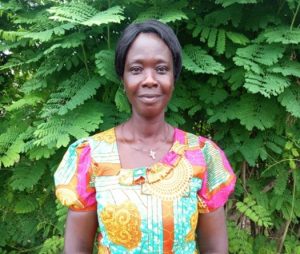 Eunice Onaajah, a women’s leader, Bachabordo provided to the women, beyond the initial training, each woman was guided to prepare a simple but practical action plan to implement in her traditional area on her return home. The women have three months to implement their action plans and are to return at the end of October/beginning of November 2025 to present to their peers the progress they have achieved. What followed in the months after the training revealed how small interventions can ripple outward into sustained community change. In Bachabordo, Mion District in the Northern Region, of the community’s six boreholes, four had stopped yielding, and the remaining two had broken down due to high use. With no functioning borehole, residents, especially women, walked long distances to fetch water from an open dam. “You must wake up as early as 4:00 a.m. to go and fetch the water… and you come back around 8:00 a.m. Because it’s far,” recalled Eunice Onaajah, one of the trained traditional leaders. The water was often unclean, and if one arrived late, animals muddied it, making it unsafe for use. “During the dry season, the dam dried up completely. If you don’t get water, you can’t cook. You can’t even go to the farm… you have to spend your productive time looking for water,” she explained. 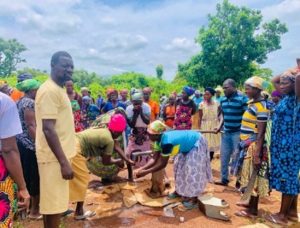 Women in Bachabordo Community after borehole repair After participating in the SIGRA training, Eunice drew a practical lesson: “We should not put all our burden on government; we can also mobilize to help ourselves.” Guided by her action plan, she led women to contribute GHS 5.00 each, and with additional support from other residents and the Water Management Committee, raised GHS 3,600 to repair two boreholes. The result was immediate. Water began flowing again, and women expressed pride in their achievement. Encouraged by her example, the men also organized to patch their town roads. The initiative demonstrated that local problem-solving works, that women’s leadership fosters participation, and that simple planning can spark sustainable change and inspire wider community action. Eunice now plans to organize the women in her community again to mechanize the boreholes for reliable dry season use. In Nanumba South District, similar lessons emerged. Near Sapki’s community dam, farmers had been applying ‘condemn’ fertilizers along the water’s edge. Runoff polluted the dam, making it unsafe for use. After the training, Aminu Tani, a women’s leader, organized a sensitization meeting attended by 28 community members (22F, 6M). The chief in the community showed interest and sent his representative to attend the meeting. Using simple explanations, she described how fertilizer residues and plastic waste were polluting the dam and the need to stop indiscriminate cutting down of trees especially around the dam. By the end of the meeting, farmers agreed to stop applying chemicals near the dam and to maintain a natural buffer zone around the dam. The men also volunteered to monitor indiscriminate tree cutting. Farther south, in Anloga District of the Volta Region, Queen Mothers adapted the knowledge to coastal challenges where lagoon salinity and years of fertilizer use had reduced soil fertility. Mama Ketor II, on returning from the training, engaged 11 farmers (10M, 1F) on the dangers of excessive fertilizer use and the benefits of organic compost. She encouraged the revival of hardy local tomato varieties such as “Lorry Tyre”, better suited to local conditions when combined with organic manure. To reach more farmers, she partnered with the chief, who purchased airtime on Jubilee FM for her to host a discussion on organic farming. The broadcast reached farmers across the district and drew call-ins from listeners who shared similar struggles with soil salinity and pesticide  Mama Ketor II, Queen Mother of Anloga costs. Mama Ketor also plans to organize a tree planting event with basic 4 pupils of the school in her community to plant trees to create more awareness about climate issues in her community. Other Queen Mothers followed suit. In Srogboe, Mama Constancia Letsu established an organic cassava and vegetable farm and planted mango trees around it to conserve moisture and provide income. She invited 12 residents (10F, 2M) to her backyard farm to learn how to make and use compost. In Tigbe, Mama Edith Awuye started an organic cassava and vegetable plot and trained 20 women farmers in composting and mixed-cropping techniques. Mama Josephine Tatra led community education sessions on organic farming with 11 women and 1 man participating. These practical demonstrations showed that agroecology is not abstract theory but a viable, locally appropriate farming system. 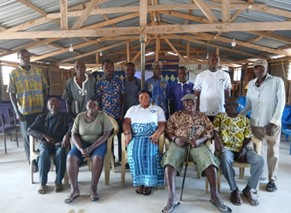 Mama Ketor II, Queen Mother meeting with farmers in her community Across these districts, the results of SIGRA’s agroecology and climate action training to date are visible, both in environmental protection/adaptation and in the strengthening roles of women leaders. Queen Mothers and traditional women leaders, who once hesitated to speak publicly, are leading by example. Their projects, though modest, have delivered tangible benefits, having mobilized all financing on their own. The transformation was supported by CIKOD’s culturally grounded facilitation, which linked new techniques to indigenous practice. Moreover, SIGRA’s partner MMDAs, who have seen the successes achieved by the traditional women’s leaders, have incorporated them into their climate adaptation projects for subsequent years. Planning leadership training for more Queen Mothers, recognizing their key role as partners and leaders in climate adaptation and engaging Queen Mothers in water management and sustainably; strengthening the voice and role of women in local development and climate adaptation planning. Only two months have passed since the initial training, the Queen Mothers and traditional women leaders are still to report back in October and November. However, the successes to date prove that with minimal resources but strong social capital, women leaders can mobilize entire communities for climate adaptation. The experience highlights a broader lesson for Ghana’s climate programming: capacity building achieves lasting impact when it strengthens local leadership, respects traditional authority, and turns theory into simple, actionable steps. The SIGRA agroecology and climate action planning sessions did more than build capacity, they positioned traditional women leaders as credible voices in environmental and climate adaptation governance. Their actions show how gender-responsive approaches can transform vulnerability into resilience. |